Your AI Strategy, LegisPro Architecture
September 29, 2026
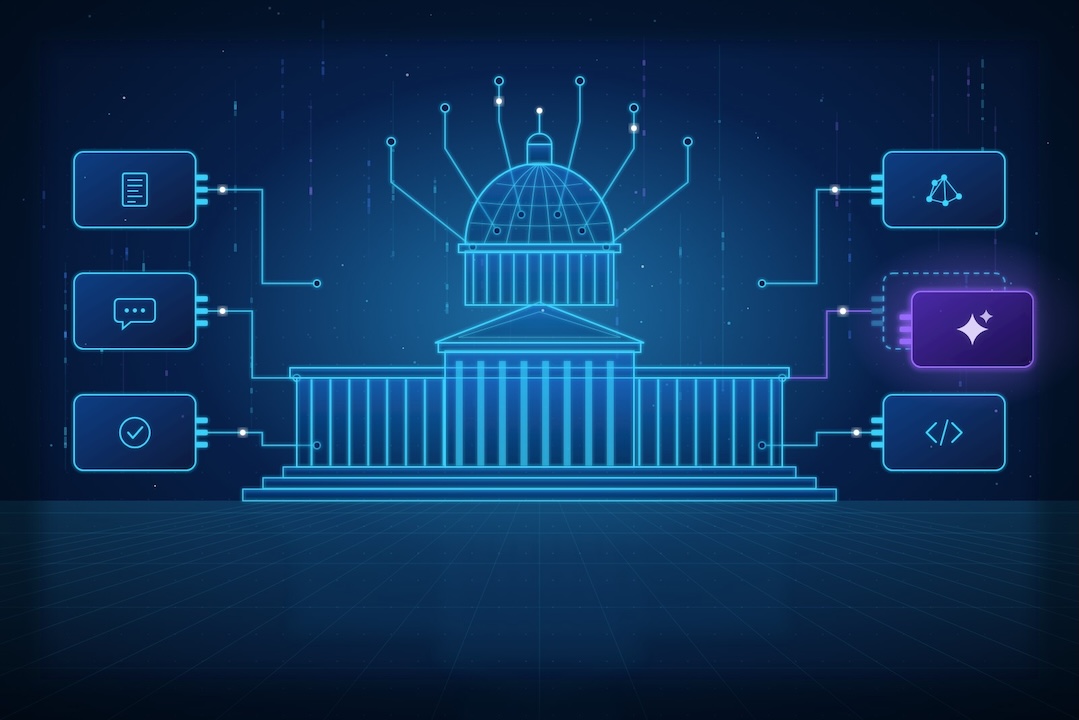

You have a strategy. We have a strategy. Everyone has an AI strategy.
Can our strategies coincide or do they create friction? Do they enable each other?
Xcential Legislative Technologies has an AI strategy rooted in "enabling architecture". And the parliaments we work for have AI strategies.
LegisPro has been designed to enable your AI strategy. We want to take a couple of minutes to explain how.
Plug-In Architecture
LegisPro is “unopinionated” about how you should use AI. This is positive because strategies today are resulting in tests and pilot projects.
The way a parliament used AI in 2025 has changed in 2026, and it should be expected to change again and again in the next few years. Models are evolving, tools are becoming better understood, and the AI vendors themselves are evolving companies looking for new revenue and product lines.
In 2026, LegisPro released a mature “plug-in architecture”. Even without AI, this allows parliaments to swap out spellcheckers, adjust document models, and enable workflow automations. Parliaments are building customizations that fit their systems, their users and their publishing needs.
Some key points of value of the plug-in architecture include:
- You change the configuration, not the code. Changing a ribbon tab, CSS stylesheets, a tool group, side panels, and more can be accomplished without touching the source code. Jurisdictions can shape their drafting environment in a safe manner, without the risk of making source code changes to the editor, database, or other services.
For example: a parliament could add an AI drafting-assistant side panel as a plug-in, pointing at a model it has approved (hosted in-country if required). When a better model arrives, or procurement rules change, it swaps the endpoint in configuration without touching or re-procuring the editor.
- Customers and partners can continue to customize. In-house IT teams and partners can write customizations to LegisPro without the risk of changing source code. This enables LegisPro to be functionally extended with standard tools like VS Code, JSON, and JavaScript.
- Different setups for different users. Plug-ins can be turned on and off through settings, so that drafters can get one set of plug-ins (custom drafting functionality) and editors can receive another set of plug-ins (custom editing functionality). One group of users can pilot AI projects, while others continue without the pilot.
LegisPro’s purpose-built, plug-in architecture is built for your AI strategy. Ours and yours working together.
The strategy from Xcential is to provide customers a path to AI services that can change as AI changes and our collective understanding of what is a good use of AI evolves.
LegisPro Publishes Legislation AI can Read
Flexibility is half the story. The other half is the quality of what you feed AI.
Xcential believes an immediate challenge for parliaments today is to publish AI-ingestible information. Why? Because citizens are consuming your information via AI today.
Structured legislative information, in Akoma Ntoso, is an output (or product) of LegisPro. AI can read this structured information and reason on top of it. Citation graphs for cross-references are another natural output of LegisPro.
LegisPro provides the outputs you need to build MCP servers (which let AI assistants look up your official text directly) and model training materials (used if you are training your own model) to engineer your way to precise and citable answers from AI (for citizens and parliaments).
LegisPro as an AI Enabler
AI suggestions arrive like any other proposed change: visible, attributable and reversible. With LegisPro, the office and the drafter stay in control.
LegisPro enables your AI strategy through a plug-in architecture to add, swap or remove AI tools, and structured, citable legislation that AI can read accurately.
At Xcential, we are not “doing AI” to join the crowd. We provide enabling architecture to help you build your AI services the way you want.